The Serious Mirth Society

Deliberately Making Fun.

Turtles Stock photos by Vecteezy

In 1958, Dr. Seuss wrote a story called Yertle the Turtle about a nice little pond called Sala-ma-Sond, where there were enough resources for everyone to thrive. But Yertle, the turtle king, sat on his little rock throne and was not happy. He had already decided he owned everything he could see, but it wasn’t enough. He wanted to see more, own more, be king of more.

(This is a work of fiction, of course. And while you could say that any resemblance to actual persons, living or dead, or actual events, is purely coincidental, Seuss was very clear that he based Yertle directly on Adolf Hitler. Any connections to current events, therefore, is entirely up to you.)

So Yertle commanded the surrounding turtles to climb up in a pile, with him always at the top, of course, so he could be higher and see further. And for some reason, the turtles did. (We never quite understood what they thought they were getting out of this arrangement. Yertle was always very clear this was completely about him.)

It was a turtle named Mack, on the very bottom of the pile, who spoke up, explaining to the king that this was hurting them. That they were hungry and sore and tired. Yertle got mad and told Mack he didn’t matter (an interesting point, considering Mack was the foundation of Yertle’s pile). Then Yertle ordered even more turtles to climb up so he could be even higher, king of even more. And, for some reason, they did.

Then Mack spoke up again, pleading that the turtles who were in great pain, and starving. Yertle yelled at him again, saying Mack had no right to even speak to such an important king as him, and demanded the pile grow even higher.

But then Mack did something interesting.

He didn’t do anything big.

He did something small.

“He burped. And his burp shook the throne of the king.”

And Mack’s little burp sent such a shock up the turtle pile that Yertle lost his balance and the entire turtle tower collapsed, leaving Yertle down in the pond, “the king of the mud.”

So whatever it is you are doing today, please remember to burp, in whatever way you are best at burping. Every burp matters. Each little burp can help dislodge a king from his throne. Although burping in large groups could be magnificent, too. (Whatever you do, at least try not to climb into the turtle pile?)

And so, in honor of Dr. Seuss, and in honor of No Kings Day, we offer this “Call to Burping:”

Please burp in your home, please burp in your church
Burp anywhere that makes the turtle pile lurch

You can burp in the streets, you can burp in the mall
You can burp anywhere, make the turtle pile fall

No one needs a king who can see for a mile
For turtles should not be stacked up in a pile

They should be alive, eating food, having fun
In a line, on a log, being warm in the sun

So please burp as you’re able, if, we hope, you agree
That turtles, as all living things, should be free.

Here beginneth a geeky language lesson:

sist: in language, a root form, from the Latin “sistere,” meaning “to stop, to check, or to cause to stand.”

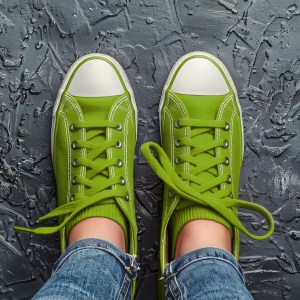
Feet in green sneakers wearing jeans standing on a black surface.

The “sist” root in a word shows a person’s location, albeit metaphorically. It indicates their stance, where they stand. It is not technically related to the origins of the word sister, although this week, after this election, it seems extraordinarily related.

It is actually related to the word “position”—where you’re standing (or sitting, or lying down on the floor staring at the ceiling in existential angst). It’s where your mind is. Where your feet are.

Ironically (though again, very appropriately), “sist” is what is known as a “bound root”—it can’t stand alone. It requires a prefix to show context—like needing a second marker on a map so you can really see where you are, in relationship to something or someone.

And so, “To sist, or not to sist: that is the question.” Where are you standing? Who with? And what are you doing there?

Aspiring to be helpful, we gathered some useful words to know for the future, including some helpful examples of how to use them in a sentence (and just maybe, especially, in your life):

~~~~~

as-: a form of “at” meaning to, toward
assist: literally: to stand near, next to > generally: to help
>> They assisted their friend when her life was in danger.

~~~~~

con-: from “com” meaning with, together
consist: literally: to stand firm > also: to be made up of
>> They consistently assisted their friend when her life consisted of threats.

~~~~~

de-: not, undo, down, away from
desist: to stop, cease from action
>> They did not desist in assisting their friend until her persecutors desisted harming her.

~~~~~

ex-: out of, from
exist: (orig: ex-sist) to step out, stand forth, to have actual being of any kind
>> A woman exists as a being with her own rights and freedoms.

~~~~~

in-: in, on, upon
insist: to take a stand, to stand on
>> They insisted their friend have the right to make decisions for herself.

~~~~~

per-: through, entirely, utterly
persist: continue steadily and firmly, especially in spite of opposition
>> They persistently insisted that their friend have the right to make decisions for herself.

~~~~~

re-: turning back, opposition
resist: to stop or hinder, to hold out against
>> They resisted opposition until their friend’s rights were restored.

~~~~~

sub-: under, down
subsist: to stand firm, to stay, to hold true, to exist > also: to have the necessities of life, to nourish oneself
>> A woman’s right to make her own decisions should subsist throughout her entire life.

~~~~~

Here endeth the geeky language lesson. We hope it’s been helpful.

Resist! Persist! Exist! Insist!

(a terribly obvious morality tale)

A while ago, in a place not hard to find, a hairy brown ape wandered aimlessly in a forest, dragging his thick, hairy knuckles on the ground. The frog Fain played in a puddle, splashing and catching water drops on his tongue. The ape lumbered by and carelessly kicked a rock, which thumped Fain on his nose and pinned him in the water. Fain spluttered and hiccupped and dragged himself out from under the rock. Scratched and bleeding, he watched as the ape went galumphing down the path without noticing what had happened. Fain crossed his eyes to inspect his scratches and groaned.

“That looks like it hurt,” called the crow Tarmegar from up in a large leafy tree. “You alright?”

“I thig tho,” said the frog, through bubbles, as he soaked his nose in the puddle. “Bud idth thor.”

“That big ape,” creaked Tarmegar. “Never watches where he’s going.”

Fain shrugged his tiny green shoulders. “It probably wasn’t on purpose,” he chirped.

“You don’t mind?” Tarmegar cocked her head sideways.

“I was told to forgive and forget,” Fain replied quietly, licking the scratches with his long, sticky tongue.

“Hah,” cackled Tarmegar, ruffling her black feathers.

Since this is that kind of story, you can probably guess this happened again. The ape kept wandering by, kicking rocks, and Fain was somehow always getting hurt. One day a rock landed on his right front flipper, then a back one. One day a rock pinned Fain’s tongue and he stretched and stretched it, gurgling and shrieking until Tarmegar flew down and pecked off the rock.

Fain looked up at the crow with big tears in his eyes. “Thack oo,” he lisped. “Ath urth.”

“Forgive and forget?” creaked Tarmegar, annoyed. Fain nodded quietly and started rolling his tongue back into his mouth.

“Maybe for you,” Tarmegar cawed.

The next time the ape came by, Tarmegar squawked at him. “Hey you big ape, watch where you’re kicking those rocks. Some of us around here are getting hurt.”

“Huh?” groaned the hairy ape, looking around. “I don’t see nothing.”

“You keep hitting that poor frog over there. One day he’ll be flat, you keep on that way.”

The ape laughed, “Flat frog, that’s funny.” The ape peered down at the frog, who was trying to hide under a leaf. He poked at Fain, who squeaked and backed up against a tree. “Flat frog, flat frog. Funny flat frog.” The ape flicked some pebbles at Fain, who shuddered and scrunched his eyes shut. “Watch out, flat frog,” the ape said, stood up, turned, and lumbered down the path.

“That ape was an ass,” Tarmegar squawked.

Fain groaned. “An ape is an ape. Why did you have to say something? You’ll only make it worse!”

“Still forgive and forget?” the crow questioned again.

“Yes,” whispered the frog. “What else am I supposed to do?”

“What about at least wearing a helmet?” Tarmegar croaked. “Find a shell or something.”

“Frogs don’t wear helmets,” Fain shrugged.

Tarmegar rolled her eyes.

Days passed, then they heard the ape scraping through the trees again. “Oho,” the ape grunted, and spotted Fain with a grin. He picked up a rock the size of the frog, reached over, and dropped the rock right on top of Fain. The frog made a squelching sound as the air squished out of him.

“Flat frog,” chuckled the ape, bending over to look closely. Fain’s eyes were wide. His mouth was wide, his lungs had no room for air. His flippers stretched and twitched.

“Flat frog!” the ape laughed again, slapped his hairy hand on the tree and trundled down the path.

“Hang on!” Tarmegar screeched, flew down and grabbed a stick in her beak. She pushed the rock until it rolled off Fain, who gasped and coughed until he could breathe again. Then he started crying.

“I don’t know what to do,” Fain sobbed through his tears.

“You,” Tarmegar croaked, “are not supposed to have to do anything.”

“Forgive and forget was supposed to work,” Fain sniffled. “That’s what they taught me.”

Tarmegar said something unrepeatable.

“Whoah,” sniffled Fain.

The next time the ape came by, he called out, teasing, “Where are you, flat frog?” Fain hid in a hole. And the next time, the ape grinned and waved his arms around, searching through the bushes yelling, “Come out, flat frog!” Fain had tunneled into some mud and only his eyes peeked out under a leaf.

“This is ridiculous,” Tarmegar squawked, dived at the ape, and pooped in his eyes. The ape lurched through the forest, crashing into trees, rubbing his stinging face wailing, “I’ll get you, stupid bird! Stupid frog!”

“Whoah,” said muddy Fain, looking up at the crow in awe.

Tarmegar chuckled, then sighed. “Sad to say, I probably just made things worse.”

One day, a lone donkey loaded with sacks came bursting through the trees, scrambling on the path and kicking rocks as he went. Fain tried to dodge, but a pebble hit his head and he shrieked, for he was still bruised and tender.

The donkey skidded to a stop. “Hello?” the donkey called into the suddenly still forest. “Is someone out there? He waited and swiveled his ears around, listening intently, looking around up to the trees and down to the ground.

“Um, just me,” chirruped Fain, scrunching his eyes closed, expecting the worst.

“Who’s me?” asked the donkey. He waited and called again, “Who’s there?”

Fain shivered, waited, then peeked out from under a leaf. “Down here.”

“Oh! Hello down there, small frog. I didn’t see you. Did I scare you? Are you hurt?”

“I just, well, a pebble hit me as you were rushing.”

“Oh no, I’m so sorry. I got lost and I didn’t know there was anyone here. I should be more careful. Are you okay?”

“It’s just a little scratch,” Fain admitted.

“I’m so sorry,” the donkey said again gently, kneeling down. “I think there’s some medicine in the smallest pack on my back. Can you reach it?”

Tarmegar, who was watching all this from her usual tree branch, flew down and pulled the strap open with her beak, helping Fain with the ointment. Then she hopped over right in front of the donkey’s nose, staring him in the eyes.

“You are not like the other oafs who come lumbering through here,” Tarmegar informed the donkey skeptically. This big ape comes through and throws rocks at Fain all the time.” She shrugged over at the bruised frog. “The frog keeps saying ‘forgive and forget’ but I think that’s the dumbest thing I’ve ever heard.” The crow huffed and flew back up to her tree.

The donkey looked over at Fain, curious. “Well, it’s not bad, but what about the whole thing?” What about the part before that?” he asked.

Fain looked lost. “What part?”

The donkey huffed. “The part that says, ‘Admit and amend.’ If I hurt someone, I have to help. Your job isn’t to make it better, that’s mine.” The donkey snorted and rolled his eyes. “I may be an ass, but I’m not a complete dumbass.”

“Whoah,” said Fain, gazing up at the donkey.

Tarmegar laughed and laughed and laughed so hard she fell out of her tree.

When my body says bye to this stretch of the sky 
And gets sunk in the dirt flowers bloom in
If I have to come back on some strange return track
I refuse to come back as a human.

A worm would be nice—any spore would suffice
Ferns that honor a tree as a steeple
I would love to be moss, or a snail’s slimy gloss
But I will NOT come back as a people.

There are billions of options much better than that
(A bird or a bat or a siamese cat)
Earth would not be the mess that it be in
With more of the creatures with laudable features
And less of the homo sapiens.

Hands down, my favorite book last year was Fredrik Backman’s Beartown. It’s about hockey, sure. But it’s really about humanity, and what happens when we base our identity, our worth, on something outside of ourselves. And how, if we do, we tend to need that thing to succeed, to WIN, in order for us to feel good. To be good. To be right. At any cost.

Backman has this great talent for including short, seemingly-offhand commentaries in his books, reflections on the nature of humanity that have all the beauty and heft of a thousand-pound feather. Delicate, but heavy. Oh sure, it looks like just another innocent paragraph, floating there on the page—until it thuds down right at your feet and sinks a 100-foot hole in the ground. Then you find yourself staring down into that abyss for an hour wondering what just happened, grateful your tiny toes are still intact. As was the case with this one:

“There are few words that are harder to explain than “loyalty.” It’s always regarded as a positive characteristic, because a lot of people would say that many of the best things people do for each other occur precisely because of loyalty. The only problem is that many of the very worst things we do to each other occur because of the same thing.”

– Fredrik Backman, Beartown

You officially have my permission to stop reading this post now and just go get the book. I understand. No hard feelings. In fact, I may go do the same thing. It’s worth reading at least twice. (And did I mention it’s a trilogy?) See you later.

But seriously, his keen observation on loyalty keeps me wondering:

What teams are we cheering for? And why?

I suppose we could ask ourselves these questions about a number of game-like things we do: sports, politics, tradition, religion, war, etc. They all request a sort of team loyalty from us. And if we say yes, whether we’re key players or fans, we’re all supporting the continuation of the “team” in some way. But how did we join these teams in the first place?

  • Do we just need to feel like we belong to something?
  • Did we decide our loyalty ourselves?
  • Was it because of tradition? If our family cheered for a team, does our continued loyalty honor them?
  • Was it because of location? If a winner is from where we’re from, are we winners too, by association?
  • Why do we get so upset if our team loses? By association, do we become losers, too?
  • When the “winners” riot, is the destruction an earned display of power?
  • When the “losers” riot, how is that framed?
  • Does our view of that depend on which one of those we were?
  • Does a financial connection, a personal gain or loss, influence our loyalty?
  • Is loyalty temporary? Or permanent?
  • What happens if we change our loyalty? In us? To us?

There are forests worth of books on the ramifications of all of this, the meanings of our loyalty to team, family, tribe, country, religion. A lot of them frame those games as zero sum outcomes needing a winner and a loser. There’s a book I love with a different idea, though: philosopher James P. Carse’s Finite and Infinite Games: A Vision of Life as Play and Possibility.

“A finite game is played for the purpose of winning, an infinite game for the purpose of continuing the play.”

– James P. Carse, Finite and Infinite Games

You are also pre-emptively forgiven if you stop reading this and just go read Carse. It’s a short, practical, wonder-full book. He writes that the finite games we’ve made up—like sports or anything with sides—were built specifically to define winners and losers. The goal is to divide the conquerors from the conquered, with variations of trophies and moral judgments awarded.

Carse suggests that our approach to life could be a very different kind of engagement, an infinite game with very different “rules.” Infinite play is not just making the same brutal games last longer. Infinite play is engineered to expand positively, allowing the players and rules to adapt and change, without the short-term “team” mentality. The hope of playing is for everyone to enjoy the playing, even to improve the playing. It’s not based on teams “winning” and “losing” in the finite sense. It’s about creating possibility and longevity. And maybe even joy.

Wouldn’t it be interesting if we chose loyalty to that kind of game? Where we each carefully chose what kind of player we were going to be and what kind of play we were going to support? Where we could make sincere choices supporting a more vibrant kind of life on a greater scale? And maybe beyond just Team People? Maybe “Team Earth” with no opponents? Maybe we could play so everyone who’s spinning on this waterball could enjoy being part of Game Universe?

Though post-humorous (typo intended), we’d like to make Professor Carse an honorary member of The Serious Mirth Society, because he knew what large-scale play could be, and we love this kind of play. He wrote that “infinite players prepare themselves to be surprised,” and how that indicates a dedication to “ceaseless growth.” Infinite play isn’t locked in to what has been, and it doesn’t need to control what might be. It doesn’t need one team to lose for another one to win. It lets everyone play, and hopefully even thrive.

And on that note, in the hope that “growth” could mean “for everyone to thrive,” when you vote this year (and PLEASE everybody, every body do the voting thing), look past loyalty to a team, and consider a more infinite game.

Can we make up more infinite games? We would really cheer for those. We could even, maybe, be loyal, even as we keep improving the game.

first of all, lie down

someplace where one is likely
to find butterflies
(the couch in front of the tv is not one of them)

stretch out in some grass
feel the green, brushy blades tickle your neck
and then—and this is the important part—

wait

let an ant make his journey over your ankle
for all you know, this may be his Mount Everest
let him survey the vastness of creation (as he sees it)
before he wanders on

allow a thin-legged spider to navigate your elbow
on her way towards the trees
feel a fly tickle your palm and lick the sugar off your skin
he means you no harm, he’s just curious
and the mosquito—well, you will have to decide that for yourself

let nature get to know you
lie there with your arms outstretched
offer yourself to everything in it
dirt up to sky, with its cotton tufts of cloud animals
every living thing, feel them move,
the branches and the birds and the breeze ruffling the trees

the leaves are waving, maybe even to you
answer only with the soft breeze of your own breath
and the thrum of your beating heart

then, and only then

maybe

will a fragile body with beautiful wings notice you,
be curious enough to see what kind of flower you are,
and swoop down in spiraling circles
to land on your nose

do not move to hold it

this is the best possible hope you have

Traditions can be wonder-full things. And we think it can also be helpful to remember that they are created things, things we repeat to remind ourselves of what we value and what we love.

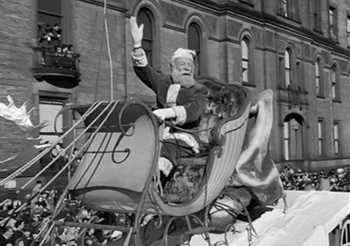
We at The Serious Mirth Society are surprised to realize our traditions now involve an annual holiday screening of “Miracle on 34th Street.” (And always the original black and white version—it’s imperative.) It’s surprising to us because every year we become increasingly aware of what a tremendous comedy of errors and tragedy of logical fallacies it is—arguably a promotion of material greed, an oversimplification of life, and quite an abominably messed-up definition of “faith.”

Every year we have new arguments about what’s wrong with this movie.

And yet we keep watching it.
(And—spoiler alert—maybe you’d like to go watch it, too, before you keep reading this.)

Why do we do this, year after year?

Well, we find we keep learning things, mostly about ourselves.

One thing we realized, just this year, is that what we’re seeing, under all the logical silliness, is that people support this particular Kris Kringle because of who he is, not just the name on his pay stub. They are drawn to this man specifically for how he lives. (Because they certainly weren’t so keen on the inebriated “Santa” he replaced in the Macy’s parade.) This Kris is admired for being kind, helpful, friendly, joyful, playful, imaginative, quick to laugh (even at himself), concerned for the happiness of others, and moves through life with ease. He stays calm even when personally attacked, but will also honestly and deftly confront people causing harm. He seeks justice.

This Kris Kringle didn’t have an agenda. He didn’t intend to start a huge department store goodwill campaign. He didn’t need to prove he was Santa Claus. He just moved along with life as it happened, embodying what he valued. He was just himself. Consistently.

It became very clear to us that what people loved and what they wanted to be real wasn’t “Santa” or the costume. It was the kind of person who was wearing that costume. And because of Kris, people noticed that those qualities were coming to life in themselves as well.

(A whole other discussion ensued as to how so many of us settle for idealizing people who wear a costume even when they don’t embody its values. A topic for another time, perhaps.)

Our final epiphany this year was that the villain should really get more credit for how far Kris’s joy spread. Without the miserable, spiteful Mr. Sawyer (the self-proclaimed “sane” person who lashed out and tried to punish Kris), there would’ve been no court trial, no national publicity or attention. Mr. Sawyer’s smallness was the catalyst for something good to grow even bigger.

Yes, of course, we admit some malevolent satisfaction at Mr. Sawyer getting fired (“Hooray for justice!”). But then we remembered that even Kris Kringle didn’t wish for Mr. Sawyer to be miserable—just held accountable. And even more, somehow, for him to be happy. Not as he is, in his pinched, Grinchy state. But maybe there’s the hope that he can grow.

And thus, our wish for everyone—may you all be happy. Spread mirth and cheer like Kris.

Tune in again next year, for tales of an exuberant discussion regarding the ethics of “Emmet Otter’s Jugband Christmas.” Remember, traditions are surprising things—especially, when you keep asking yourself why you do them.

Wishing you all a
“Merry Everything!”
from The Serious Mirth Society

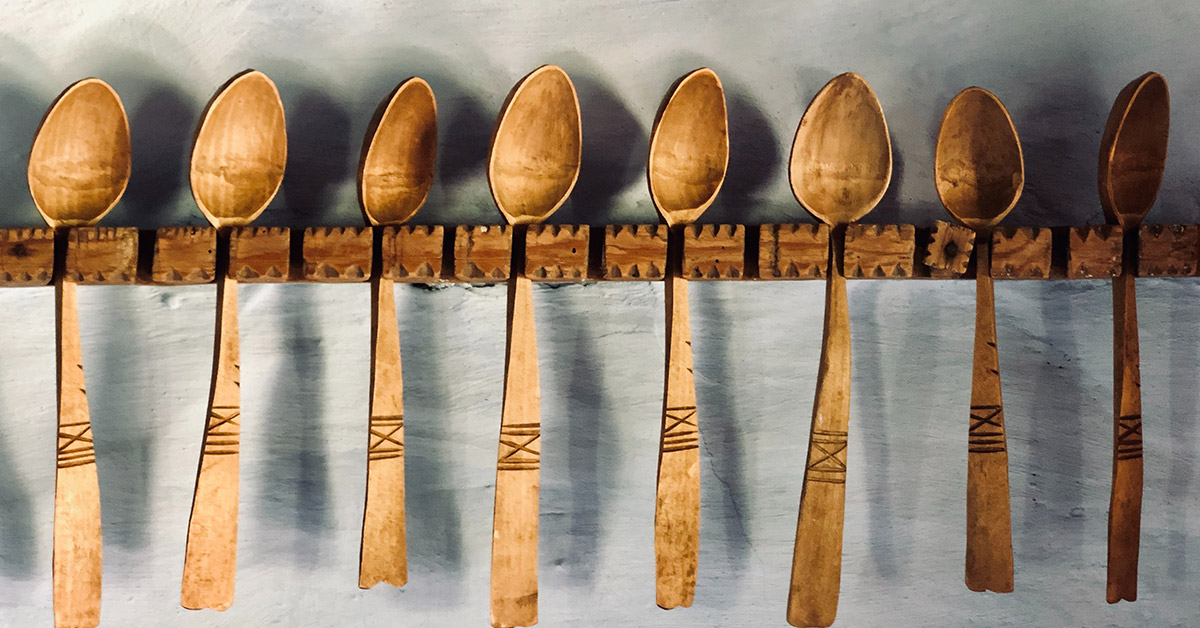
In the beginning, people ate with their hands.

At some point, they discovered that sticks could be helpful for transferring food to their mouths. Eventually, they realized that sticks with wider, curvier ends helped even more—especially with slippery things like soup.

Enter the spoon.

One day, when someone was slurping their soup, an argument broke out. Someone else got angry and hit them with their spoon. Their neighbor hit them back.

Things escalated.

It was quickly discovered that spoons could be used for terrifyingly violent things that no one had ever intended—like gouging out eyeballs.

At some point, after witnessing all the horrific spoon carnage, someone said, “This must be stopped.” And someone else agreed. And thus was born the Association for Spoon Safety.

The Association for Spoon Safety made rules so that everyone would be safe using spoons.

They made rules for eating and rules for stirring. They made rules for acceptable spoon materials and rules for how to hold them. They made rules for shaping and rules for slurping (especially slurping) They also made rules for other spoon-shaped things used for digging or gardening, because it only stood to reason. And because they decided they could.

There were rules for all spoon-shaped things. And punishments.

Still, there was spoon-shaped violence. And people were unhappy.

The leaders of the Association for Spoon Safety were soon overthrown by some of their own members who considered the rules insufficient.

They renamed themselves the Association for Spoon Savers.

They ordered all spoon-shaped objects to be collected and guarded so that no one could use them to cause further harm. They deputized people to seize all the spoons and lock them away. They created a rigorous certification process for spoon usage, and only those people were permitted to use spoons.

This made a lot of people unhappy—especially when it became clear that some of the certified spoon users were hitting people and gouging out eyeballs themselves.

These unhappy people named themselves the Association of Spoon Saviors and declared that the spoons must be liberated. They stormed the spoon strongholds and, as they left, smashed anyone who got in their way with spoon-shaped specimens.

Chaos ensued.

Historians, having unearthed texts from the various factions in question, have had great difficulty providing clarity in the matter of spoon history. There is anecdotal evidence that there were always some who just wanted to be able to eat soup, but those views were not committed to writing, and, as such, are impossible to verify. As with all anthropological efforts, subjective interpretations abound. Arguments regarding translation are heated, and issues of objective truth versus cultural tradition are difficult to validate. Slurping remains a point of great contention.

EXTRA CREDIT

Please discuss and evaluate the following statements:
• People mean well.
• The spoons were not the actual problem.
• Acronyms are important.

Human beings are odd in that we like to compete in contests we make up ourselves, usually for the highest, or, oppositely, the lowest scores. But since we at The Serious Mirth Society don’t have the slightest ability to do most of those kinds of things well, we just don’t take competition very, well, seriously.

But what we have been considering lately is the matter of distance—how far something can travel. And what we have been discussing are pumpkins—and catapults.

More than two thousand years ago, catapults were developed for assault in warfare—you know, besieging castles and the like. Thankfully, they’re now mostly considered obsolete. Unfortunately, that’s just because we just developed much deadlier weapons, arguably still trying to win contests we make up ourselves (a delicate topic for another day). We are happy to say that these days, catapults are mostly used for a better kind of competition—one testing engineering ingenuity, teamwork, and just plain fun. Since 1986, The World Championship Punkin Chunkin Association has hosted annual events to see just how far one can, for better or worse, chuck a pumpkin. (Important note: contrary to their origin, these catapults are not built to destroy—any pumpkin chucked must remain intact in order for a team to win.)

Why pumpkins? We don’t know. What would you choose?

Out of sheer curiosity, we recently posed this question to a bunch of six-year-olds. We told them about pumpkin catapults, and asked them, “What would you put in a catapult?”

We thought we were just having a laugh, but we quickly realized that we had inadvertently created a sort of Rorschach test, as we learned a lot about how these kids were wired. Here are a few of their responses:

  • “Jelly beans” (so much fun)
  • “Flaming boulders” (obviously a purist)
  • “Myself” (an aspiring acrobat?)
  • “Gifts all wrapped up and shiny” (look out, Santa)

The nature of their replies caught us off guard. Jelly beans, indeed. It wasn’t about competition—it was about fun. (Of note: the “flaming boulders” kid actually has a very kind heart—he’ll turn out just fine.)

Those kids started us thinking—what kind of world it would be if we used catapults for things like jelly beans and gifts? That would be a pretty good world. And then we started thinking along another axis of measurement—not just in distance, but in time. Because don’t we often do things in hopes of seeing how far we can throw them—into the future?

You could argue that a lot of our human contests are about making a mark in history, feeling significant, being remembered. We want our lives to be part of the future. We want to leave a legacy.

Legacy is an curious construct, something given—tangible or intangible—to future generations. Legacy shows us our story about who or what continues to be valued—both loved and despised. Legacy is something sent forward, and it has the potential to travel great distances in time—generations. Maybe legacy is a kind of tool—like a catapult—and it can be good or bad depending entirely on what’s being thrown forward, and why.

The kid who said she’d put herself in the catapult? She got us thinking—maybe that’s what we do. Maybe our catapults are our bodies and our lives—but know that we come pre-loaded with legacies. We’re full of our ancestors’s values—their genetics, their traditions, their cultures—and we need to be very aware of that. If we’re launching things forward, wouldn’t it be good for us to check our buckets to see what’s actually in there? What do you see? Are there jelly beans? Or flaming boulders? Maybe there are a lot of great things in there we are thrilled to send into the future. Shiny gifts. Undamaged pumpkins. But maybe too, there are things we could carefully remove, pour water on, and set aside. Maybe we could leave the flaming boulders behind.

It’s a delicate engineering feat, calibrating a catapult. Choosing a legacy. But it’s our job to decide. What will you put in your catapult?

It’s an understatement to say that we’re living in stressful times. The pressure is affecting us all to varying degrees, and some days it feels like there will be no release. And yet people are still choosing to speak of hope, meaning, and the importance of continued effort. We were very skeptical to say the least. Where is this energy supposed to come from, when so many people are being pressed down, mocked, and silenced? And so we started thinking of other things that feel pressure and of how they respond. Which is when we started thinking about round rubber balls. And how we started thinking about resiliency. And physics.

A round rubber ball can endure quite a violent life—being thrown, hit, or kicked around in any number of ways. But what fascinated us is how it responds when it’s not just hit again or caught safely by welcoming hands. When left to its own devices, a round rubber ball does something very interesting when it meets a surface—it stretches, it bounces, and then it rests.

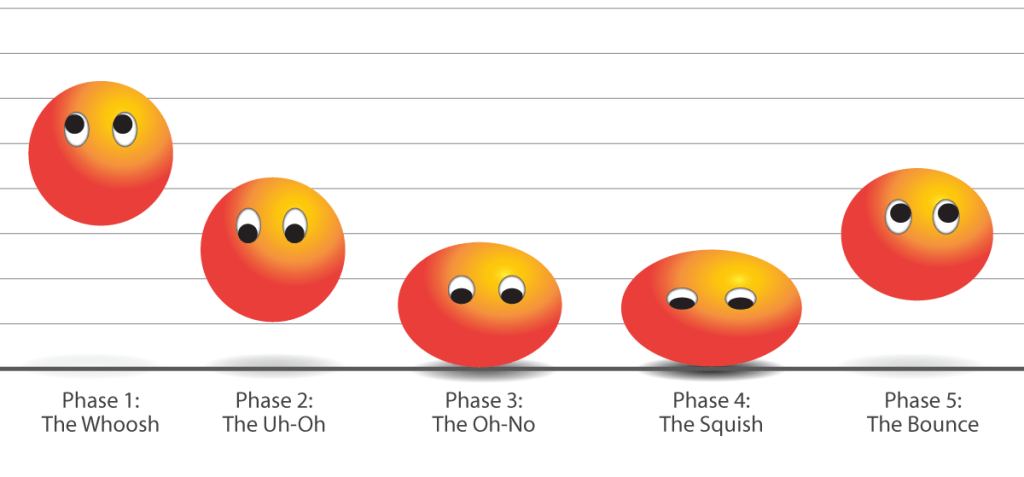
And as we thought more and more about that bounce, we realized that’s the ball’s natural response to stress. In fact, it’s the expression of release from the stress of impact. Want to learn about bounce? Pretend you’re a ball.

Phase 1: The Thrill of The Whoosh

You really have no control over how you’re launched out into the world. Once you’re off, you’re in continuous movement, interacting with all the objects around you (the ubiquitious nouns of people, places, and things). And so, regardless of the nature of your first or latest contact, here you are, sailing through the air. There’s wonder, there’s the rush of speed, the exciting feel of the air on your face. You’re flying high. But the universe has an interesting feature built in, something that Isaac Newton put a name to a few hundred years ago, and that thing is gravity. And one thing we know about gravity is that flying is temporary. What goes up must come down.

Phase 2: The Unknowing of Uh-Oh

Perhaps you swoosh through a hoop, changing direction, and now you see yourself moving towards the ground, something new. What’s going to happen? Will you be okay? Will it be fun? Will it hurt? Our uncertainty is just that—uncertainty. Not knowing. And most of us aren’t so fond of not knowing. Unless you’ve done this kind of thing a lot before, “uh-oh” is par for the course, flavored with however much of an optimist or pessimist you are, and by your past experiences of flying through the air.

Phase 3: The “No” in Oh-No

The moment of impact. Ouch. “NO,” you think, as you register the shock of hitting the ground, “I DO NOT LIKE THIS.” Part of you hurts, part of you is afraid, part of you is angry, and part of you thinks you never should’ve left the rubber tree to begin with, because this is not what you had in mind. A big part of you just wants to know when the pain will stop.

Phase 4: The Endurance of The Squish (and the Fear of The Splat)

In general, time is supposed to move consistently, but we’re just going to be honest: time in The Squish stretches out just like you do. The pressure can be painful, and your body and mind will not like it. You feel pushed into the ground, stretched out beyond what you think are your limits. Time in The Squish does not feel good. You may fear you will never regain your original shape. You may be tempted to give up hope. There are those who may thrive from the pressure in The Squish (a clue that it’s probably not their first bounce), but a lot of us simply fear this will be the end, that we will never recover, never be happy again. What we fear is not simply the pressure of The Squish. What we fear is that this is The Splat.

The Splat is a one-time-only event whether you are a human or a ball. The Splat is inevitable. Eventually, everyone will experience The Splat. (We are not making light of this, merely being honest.) The only guarantee we have as objects in space is that once we start moving, there will be a point when we come to a full stop. For the bazillions of bounces we’ll bounce in our lives, there will be one time where we will not rebound, where The Squish will not lead to The Bounce, and we will cease to exist in our current form. (What comes next we don’t know.) To face The Splat, whether our own or someone else’s, requires a great deal of bravery and kindness. But our great worry is that each time we enter a particularly intense Squish, we don’t know if it will be our Splat, so it’s unfortunately very easy to live in fear.

You might take this opportunity to point out that it would be more practical to avoid bouncing altogether and to opt for a life of rolling instead. Or, even better, hiding in the back of a shelf where you’re less likely to experience any movement at all. But even those won’t guarantee your safety, and what kind of life would that be, merely attempting to delay the coming of The Splat?

To live in fear sucks the joy out of everything. Yes, there are times when it’s wise to heed fear. But to choose it consistently is to deny our own resilient nature—the scientific fact that almost every single time, The Squish leads to The Bounce. We know that The Squish is hard. We have been there—many times, in varying degrees—and experienced countless moments of various stresses and pressures. So have you, so have your friends, and yes, so have the people you don’t even like very much. And that commonality is the biggest difference between being a round rubber ball and a human—we have company. When we are in The Squish, we can ask for help. We get to call someone we trust and say, “I am in The Squish. It hurts. I am afraid. Will you be here with me?” And there will be people who say yes. And though it seems scientifically counterintuitive, sometimes the people quickest to befriend you are there in The Squish themselves, right at that very moment.

But here’s the thing—The Squish is where the most energy is, even if you can’t feel it. It’s the answer to our question, “Where does the energy come from to keep moving?” It actually comes from the compression. And so if you can be patient and endure the slow-seeming time under pressure, however bleak or painful it seems, that support and that energy are what will propel you back up again and on to new adventures. That’s resiliency. That upward movement is the entrance to The Bounce.

Phase 5: The Joy of The Bounce

Oh, the great bounciness of bounce. The joy of being in the air again, moving intently toward whatever’s coming up next. Who knew that this was possible, that you’d get to fly again? You can delight, look around, and see new things. There’s new adventure here, new life on this side of The Squish. And yes, there’s likely another bounce coming, but now you know what to do. And you can keep an eye out for others in The Squish who might need your help. You get to take turns bouncing. And if you’re able, you can take some time to roll and rest until the next bounce.

So wherever you are, we’d ask you to take heart—your bouncy, round rubber ball heart. Whenever you experience The Squish, no matter how much pressure you’re feeling, know we are cheering for you. May you be refilled with air if you feel you’ve sprung a leak and all hope seems lost. We wish you friends. We wish you support. We wish you joyous release from The Squish, and even to make some small amount of peace with The Splat. We wish you the time and comfort to roll and rest—bounce after bounce after bounce. We wish you gladness and laughter. We wish you the bounciness of resiliency.